01
Retinal imaging
A non-invasive fundus photograph captures the retina, including its small arteries, veins and branching vessels.
Retina → vessels → signal
Venatal uses quantitative retinal biomarkers to support early insight into maternal vascular health.
Maternal vascular health matters throughout pregnancy. During pregnancy, the vessels that should widen and adapt don't always do so, and the effects can reach the whole body.
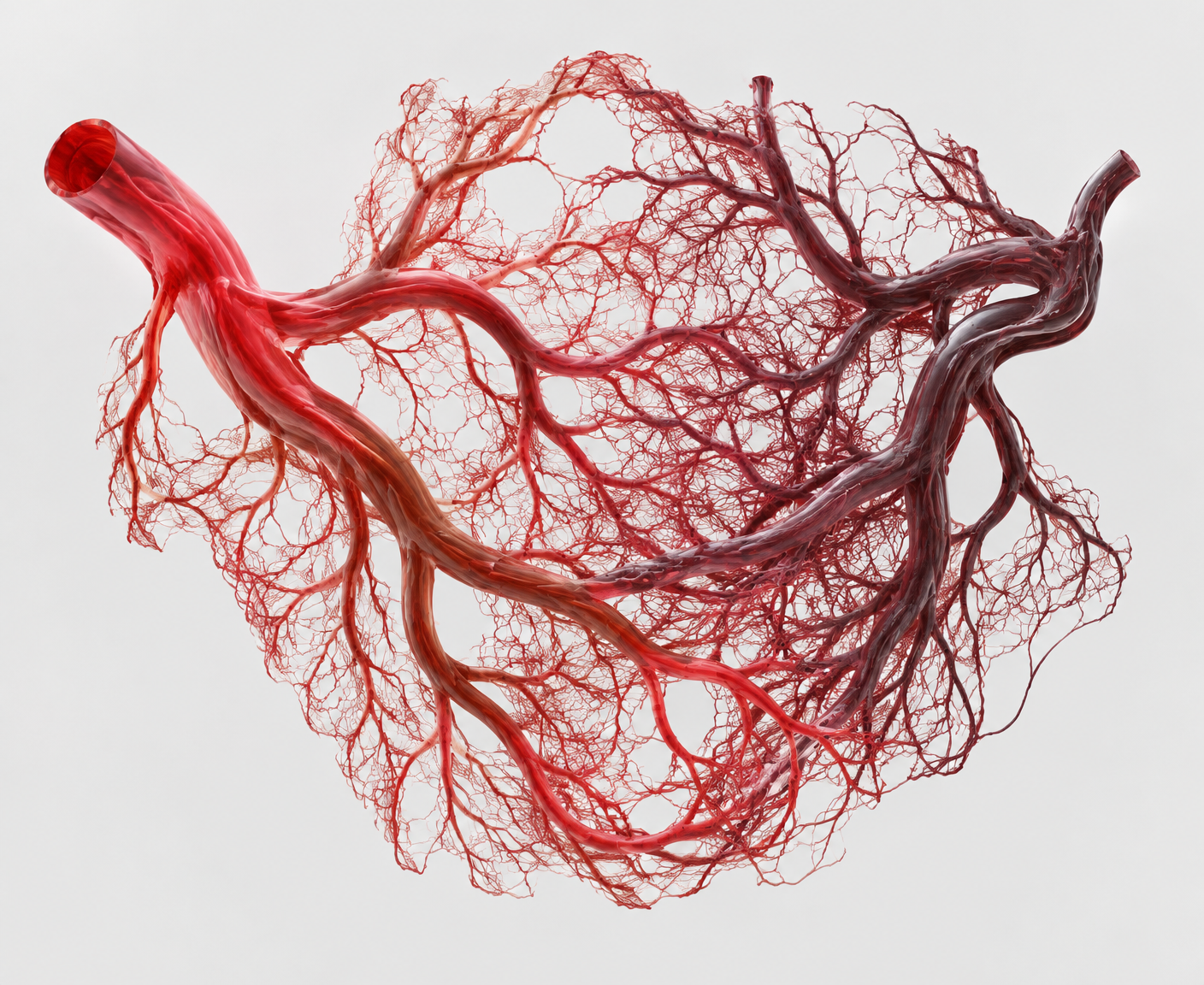
Some of these changes are hard to notice early. The small blood vessels in the retina mirror the wider circulation, so they give us another way to study what is happening.
02 — The insight
The retina contains a dense, directly observable microvascular network.
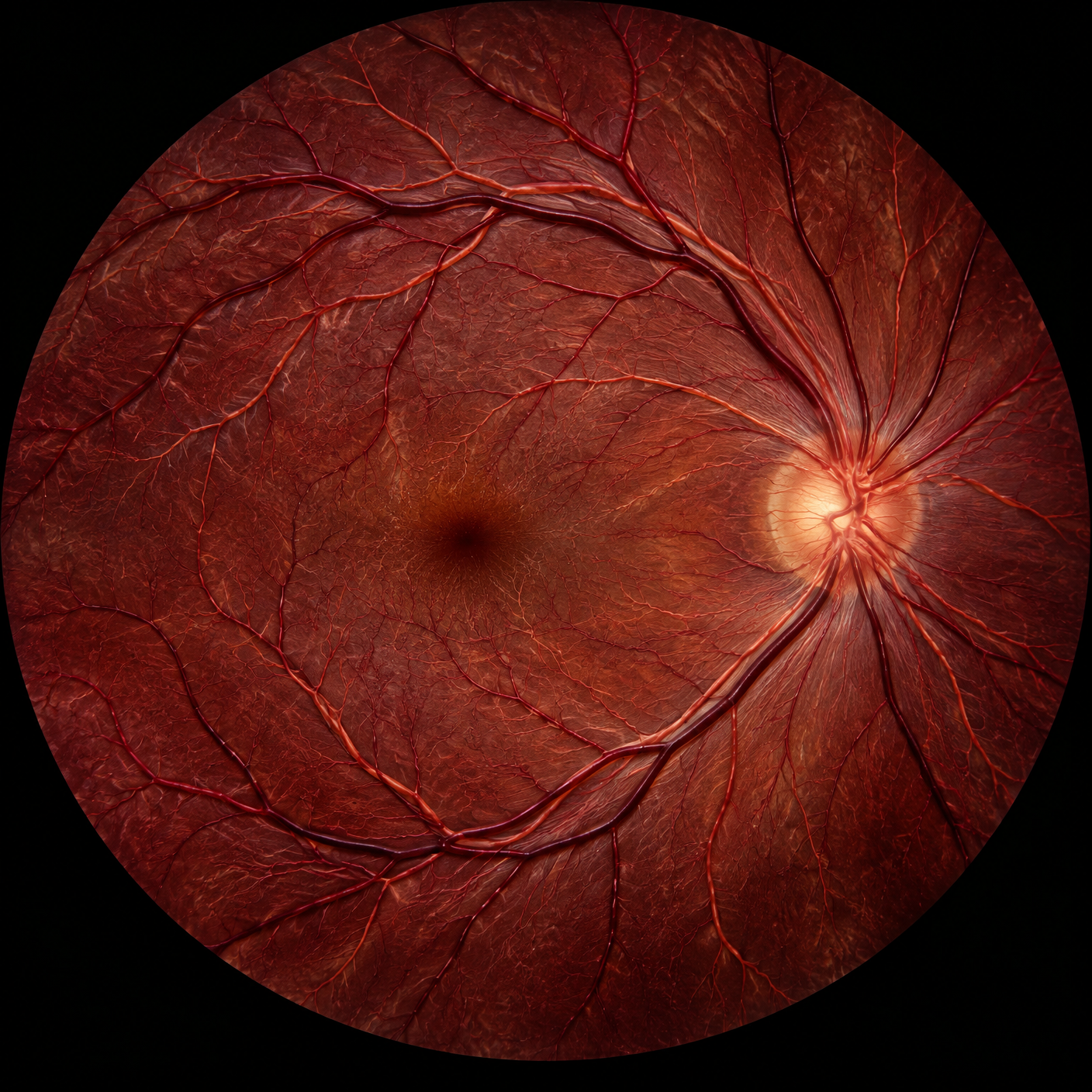
A non-invasive fundus photograph captures the retina, including its small arteries, veins and branching vessels.
Computer vision traces vessel boundaries and separates the vascular network from the surrounding retinal tissue.
Measure vessel width, curvature, density and branching geometry to build a quantitative retinal profile.
Machine learning and statistical modeling investigate relationships between retinal features and pregnancy-related outcomes.
Retinal features are combined into biological signals to study maternal vascular health and pregnancy-related outcomes.
04 — Why the retina?
A fundus photograph captures small blood vessels without an incision or blood draw, making repeat imaging practical during pregnancy.
Fundus imaging uses light rather than radiation and takes only seconds, so the same person could be imaged again across a pregnancy.
Fundus cameras are already used in routine eye clinics, high-street eye tests and mobile screening, so retinal imaging could reach places that lack specialised maternity equipment.
The retina is the only place in the body where living blood vessels can be seen directly, so vessel changes can be observed rather than inferred.
Vessel width, curvature, density and branching can be counted from a single image, turning something you can look at into numbers a model can study.
05 — Beyond pregnancy
Venatal is already exploring retinal biomarkers beyond pregnancy. The same phenotyping framework — vessel caliber, branching, tortuosity, density and geometry — is used to study how retinal vessel structure relates to systemic vascular and metabolic biology.
Areas we are exploring
Blood-pressure-related vessel change, including hypertensive remodelling of small vessels.
Cardiovascular health, including vessel caliber and branching patterns linked to heart disease.
Cerebrovascular health, including stroke-related risk.
Kidney microvascular processes, including filtration-related vessel change.
Metabolic health, including diabetes and broader metabolic dysfunction.
Venatal is a biotechnology company combining retinal imaging and artificial intelligence to advance maternal health.
We are a small team of curious minds drawn to the potential of the eye as a non-invasive, accessible source of biological information. Our initial focus is maternal vascular health.
We are especially interested in improving access to maternal healthcare in rural and underserved communities, where specialists and advanced testing may not always be close by. We aim to develop approaches that are practical, rapid, and easier to bring into everyday care. At its core, Venatal is about using biology and technology to make meaningful health information accessible to all.
We are driven by curiosity, science, and the belief that better healthcare should be accessible to everyone. We bring together clinical research, technology, and a willingness to ask new questions in the hope of building tools that can reach people wherever they are.
Founder and CEO, Venatal
Aimen leads Venatal's clinical research and scientific direction, with a focus on retinal imaging and emerging AI applications in maternal health. She translates clinical questions into research programmes that can be evaluated through real-world imaging and clinical collaborations.
Venatal develops retinal biomarkers for maternal health. Biomarker development is complete, and validation is the next phase. These biomarkers are not a substitute for clinical assessment or medical advice.
The retina is one of the few places where small blood vessels can be imaged directly and non-invasively. Pregnancy places significant demands on the vascular system, so the retina may offer a visible window into those changes.
Machine learning measures vessel width, branching and other retinal features to build quantitative biological profiles. Biomarker development is complete; the next phase evaluates these methods through validation.
No. This website does not collect personal or health data, and it uses no tracking cookies or analytics.
We are not recruiting participants through this site. Any future research will run through institutional partners with ethics approval and informed consent.
Clinicians, ophthalmologists, obstetricians, maternal-fetal medicine specialists, imaging scientists, and computational researchers interested in retinal biomarkers and maternal health.
We are interested in connecting with clinicians, researchers, ophthalmologists, obstetricians, maternal-fetal medicine specialists, imaging scientists, and computational researchers interested in retinal biomarkers and maternal health.